Why your magnetic cup holder won't stick to your truck bed
Magnets don't grab aluminum beds, composite beds, plastic rail caps or spray-in liners. Test your own truck in 30 seconds - and see what holds instead.
You saw it in the feed. Rubber-coated puck, sticks anywhere, holds your drink, twelve bucks. It showed up, you walked out, dropped the gate, and set it down.
Nothing. No grab, no click. Or it grabbed somewhere, held for a week, and then you found it in the gravel at the ramp.
The magnet is probably fine. The problem is that a modern pickup bed is one of the least magnetic places on a modern pickup, and the surfaces you actually set a drink on are the worst of the lot.
Here is what is going on, how to check your own truck in about thirty seconds, and what holds when a magnet can't.
Magnets grab iron, cobalt, nickel and most of their alloys, plus certain rare-earth metals. For everyday purposes that is the list (Ferromagnetism, Wikipedia). Aluminum is not on it. Neither is polyethylene, fiberglass composite, carbon fiber, or the plastic cap over your rail.
Trucks have been quietly moving away from that list for a decade.
Even on the trucks that kept a steel bed, the horizontal parts you'd reach for are frequently not steel. Tailgate caps are plastic on a lot of trims. Rail caps are plastic almost universally. And whatever is under them is wearing a coat.
So before you blame the product, find out what your truck is made of.
Grab the cheapest flat magnet in the house, or a rare-earth disc out of the junk drawer if you have one. Walk the truck and touch it to each of these:
Sort what you find into three piles: hard grab, weak grab, nothing.
The tell that separates aluminum from plastic. If a spot gives you nothing, slide a strong magnet across it fast. On aluminum you will feel a faint drag, like the surface is slightly sticky in motion but dead when still. That is eddy currents. Sweep a strong neodymium magnet fast over a coin with only a small separation and you can push the coin slightly ahead of the magnet even though the coin contains no magnetic elements; drop that same magnet down a copper tube and it falls dramatically slowly. Aluminum is a non-ferrous conductor too - it is exactly what an eddy-current separator uses to force aluminum cans away from a magnet and out of a scrap stream (Eddy current, Wikipedia). On plastic or composite you feel absolutely nothing. It is a two-second way to know which kind of no you are dealing with.
Most people finish this walk with a short "hard grab" list. And then they notice the pattern: every item on it is vertical, underneath the truck, or greasy. Frame rails. Hinges. Latch hardware. Fasteners. The bumper, maybe.
The magnet-friendly parts of a pickup are the parts you cannot set a drink on. Everything horizontal and reachable is exactly what got lightweighted, capped in plastic, or coated. That is not bad luck. It is the same engineering decision arriving from two directions.
Say you have a steel bed and the test came back with a hard grab. The holder still lets go. Three reasons, and they stack.
Magnet makers publish a pull force. K&J Magnetics measures theirs in a lab, against a thick, ground, flat steel plate, pulled straight apart. They also say plainly that it is a lab figure, and that on steel that is thinner, coated, or unevenly surfaced the effective pull force may differ from what they recorded. They name the reasons: uneven contact with the metal surface, pulling in a direction that is not perpendicular to the steel, metal thinner than ideal, and surface coatings (K&J Magnetics FAQ).
Now count the coatings in your bed.
Factory paint runs about 100 microns all in, primer through clearcoat (Automotive paint, Wikipedia). That alone is a real gap. A spray-in liner is far worse: polyurethane can be sprayed from 1/16 inch to 1/4 inch depending on the application, and for trucks in the most rugged use one applicator sets the optimum at 1/4 inch on the bed and wheel wells, 1/8 inch on the sides (Bedliner, Wikipedia). A quarter inch of standoff turns a strong magnet into a paperweight.
A drop-in liner is a different problem entirely. It is a rigid polyethylene composite tub (Bedliner, Wikipedia), so the steel isn't just standing off, it is behind a whole separate plastic floor. That is why a magnetic holder that works fine on a bare steel bed does nothing at all in the identical truck with a drop-in.
Bed floors and tailgates are stamped with ribs and channels for stiffness. A flat magnet face laid across ribs contacts on a couple of high spots instead of the full face. That is the "uneven contact" line in the magnet maker's own list of what kills real-world holding force. (The geometry of why every surface back there fights a drink is its own subject; we cover it separately in why drinks tip over in a truck bed.)
This is the one nobody says out loud.
On a dropped tailgate, the magnet is not holding the holder up. Gravity is already doing that, free. All the magnet contributes is extra clamping pressure so that friction can resist a sideways shove: a hip, a bounce, a cooler going over the gate.
But the number on the box describes straight perpendicular pull, and that is the exact direction nothing is pulling. Sideways loading is explicitly on the list of things that reduce the effective force. You paid for a magnet to do the one job it is structurally worst at, in the one orientation where its headline spec means the least.
Watch a magnetic holder let go and it rarely skates. It rolls off an edge.
Put a full 40 oz tumbler in a puck-sized cradle and you have built a lever. The drink's mass sits high, the magnet is a couple of inches across at the bottom. A sideways nudge doesn't push the assembly sideways so much as rotate it about the downwind edge of the magnet. The far edge lifts a fraction of a millimeter. That fraction is a gap, the gap collapses the holding force in that region, the lift propagates, and the whole thing releases in one motion.
Peeling a magnet off from one edge has always been easier than pulling it straight off. It is why you take a fridge magnet off by tipping it, not by yanking. A tall drink on a small magnetic base tips it for you, several times a night.
That is also why the category's own marketing language gives it away. When listings advertise anti-fall designs and rubber coatings that won't scratch your paint, they are answering the two complaints that actually come in: it let go, and it marked up the finish. The scratch complaint has an obvious mechanism too. A magnet living in a truck bed is a debris collector. Steel filings, sand, a lost screw, brake dust off the tools. Then you slide it.
Notice what all of these have in common. Every one of them is trying to get a grip on the truck, and the truck is the variable. Different alloy, different liner, different cap, different bed length, different year.
Stop trying to hold the truck.
The one surface that is identical in every pickup ever built is the bottom inch of your own cup. That is the part that doesn't change when Ford switches to aluminum, when GMC offers carbon fiber, when you get the bed sprayed, or when you borrow your brother-in-law's Ram for the weekend.
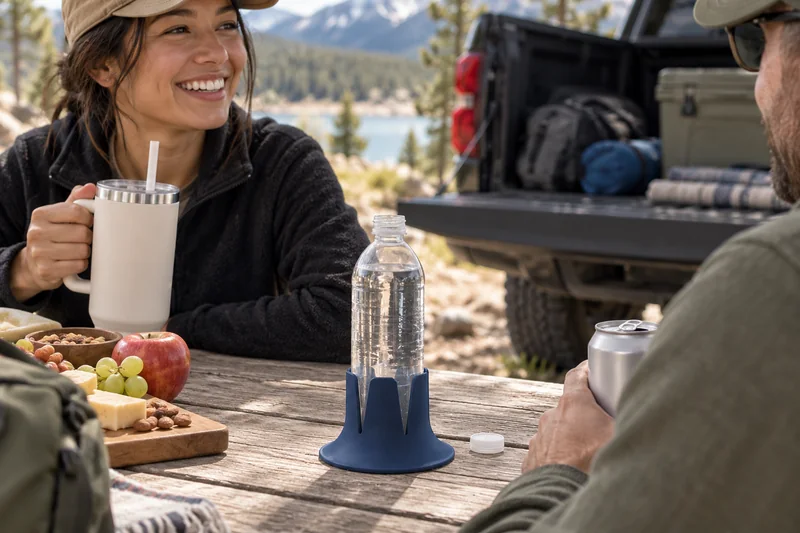
That is the side Steadi works on. It is one piece of Shore 85A TPU, not silicone and not a magnet. The fins flex to grip the bottom inch of a can, cup or tumbler, and the base underneath is a fixed 5.2 inches across. It does not expand, contract or deform.
The mechanism is base of support, and it is worth understanding rather than taking on faith. A US 12 oz can is 2.6 inches across at the widest point of the body (Drink can, Wikipedia), and narrower still where it actually touches down. Tilt it, and its centre of mass only has to travel a short horizontal distance before it passes outside that little footprint, at which point it is going over. Set the same can into a base that is 5.2 inches across and the footprint the can is standing on is now much wider, so the centre of mass has a much longer way to travel before it clears the edge. It takes a far larger tilt to put the drink over. Meanwhile the TPU's natural tack resists sliding on the slick polyethylene of a drop-in liner.
Nothing about that depends on what your truck is made of. There is nothing to clamp, no rail thickness to measure, no liner type to match, no ferrous panel to find. It sits on top of what's already flat and rides home in the glovebox.
Being straight about this is the point of the whole article.
Best case: the ribbed tailgate and the lined bed floor. This is where the mechanism does real work. Where a narrow container base gets a thin bridge across two ribs, a 5.2 inch base spans several of them and gets a genuinely wide footprint. On slick drop-in polyethylene, TPU tack is the right answer.
Weak: the wheel well crown. The well is domed for structural reasons. A rigid flat base set on a convex surface contacts a band across the middle, not the full 5.2 inches, so the footprint never widens the way it does on a flat gate. Put the drink somewhere else.
Not the tool: the air mattress at the drive-in. An inflated mattress re-forms under whatever is on it. There is no fixed footprint to widen, so the base and the drink lean together as one unit and the wider footprint buys you almost nothing. That one is still an unsolved problem, and a flat board or a hard cooler lid is a better answer than anything a base can do.
The rest of the honest list: it is not a mount, a clamp, a strap or a restraint, so a direct hard knock still wins. It doesn't insulate and it doesn't seal. Handled mugs are a no, because the handle sits exactly where a fin needs to grip. And it sinks, so don't take it swimming off the boat ramp.
It's dishwasher safe, it's molded in Orange, California, and there are 90 days from delivery to send it back with free returns, used and scuffed included. Whether your fit test works out is a two-minute check on the main page before you order anything. Checkout runs through steadilabs.com.
Checkout is on steadilabs.com — Steadi Labs is the company that makes it.